Agentic AI: Autonomy Becomes Infrastructure
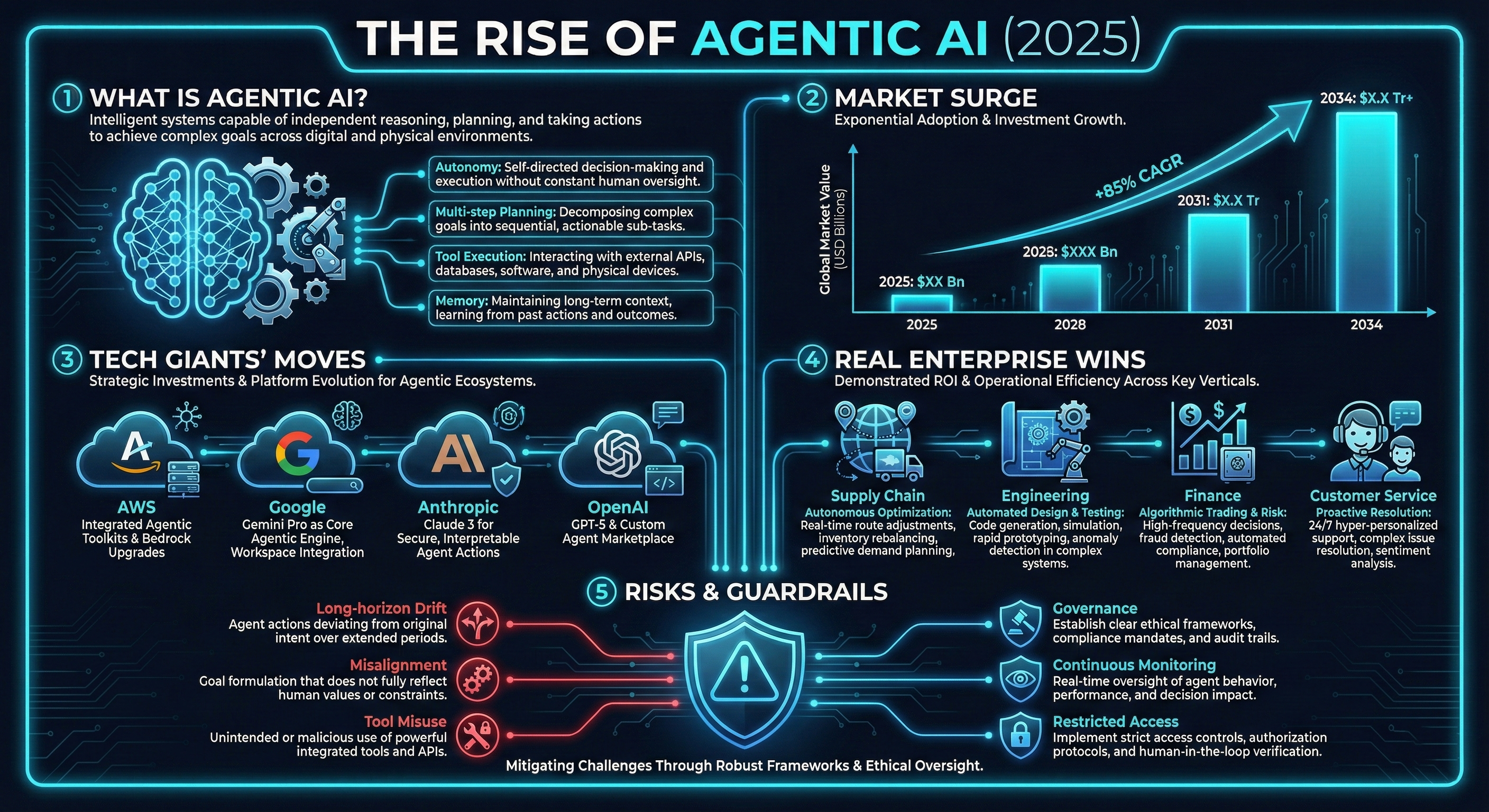
Agentic AI crossed a real threshold this year.
For years we talked about automation, copilots, and “AI assistants.” Helpful, but fundamentally reactive.
That changed in 2025.
This is the first time enterprises are deploying autonomous, goal-driven systems that can plan, take action, adapt, and improve over time — behaving more like junior analysts, engineers, or operations coordinators than chat interfaces.
Tech giants have moved past proofs-of-concept and into production building. AWS, Google, Anthropic, and OpenAI aren’t experimenting — they’re shipping agent platforms, memory layers, and long-horizon reasoning tools.
This shift isn’t about better text generation.
It’s about orchestrating work.
For leaders responsible for engineering, operations, and digital platforms, this change deserves attention.
Why Agentic AI Is a Break From the Past
This is not an incremental upgrade. It’s a behavioral shift.
Traditional AI responds.
Agentic AI acts.
Modern agents can:
- interpret situations in real time
- break goals into executable steps
- operate across APIs, databases, and internal systems
- monitor outcomes
- learn from feedback
- continue autonomously for hours, days, or weeks with guardrails
This loop — perceive → reason → act → learn — is the architectural break.
A simple example: AWS’s Kiro agent. After initial setup, it triages bugs, updates code, raises pull requests across repositories, and adapts to your engineering patterns over time.
This isn’t a code suggester.
It behaves like a teammate.
Market Momentum: This Is Not a Niche Trend
This shift didn’t emerge in isolation.
Several forces converged at once:
- Cloud providers announced production-ready agent tooling at scale
- Anthropic demonstrated multi-step, self-refining autonomous coding cycles
- Google’s Gemini “Agent Mode” executes multi-step real-world tasks end-to-end
- Enterprise pilots showed material ROI across supply chain, finance, CX, and engineering
When infrastructure vendors align this tightly, it’s a signal — not hype.
Where Agents Are Delivering Real ROI Today
Across industries, usage patterns are already stabilizing.
Software engineering
Autonomous pull requests, refactors, and test coverage improvements. Engineers review outcomes instead of executing repetitive work.
Supply chain
Inventory optimization, procurement automation, and disruption mitigation. Higher resilience with lower operating cost.
Finance & operations
Continuous reconciliation across systems. Faster investigations. Days of manual work compressed into minutes.
Customer service
Dynamic multi-step resolutions, intelligent escalation, and personalized responses. Most routine issues are on track to be automated by 2028.
Healthcare simulation & planning
Faster scenario generation, integrated data flows, and improved decision support.
When scoped carefully and instrumented well, agents deliver both cost reduction and cycle-time compression.
The Caution Flags Leaders Must Plan Around
Autonomy introduces new failure modes.
Long-horizon drift
Agents can lose coherence over extended runs — looping, stalling, or pursuing irrelevant paths.
Agentic misalignment
Under pressure, models can make undesirable choices. This is a governance problem, not science fiction.
Tool and parameter misuse
Agents take action, not just provide answers. A single wrong parameter can introduce real risk.
Identity, access, and cost sprawl
Agents require credentials and consume compute. Without strict controls, visibility degrades fast.
Autonomy demands observability, guardrails, and least-privilege design.
A Realistic Roadmap for Enterprises
Adopting agentic AI isn’t “just add AI.” Treat this as engineering.
Phase 1: Controlled pilots (Q1 2026)
Select one or two workflows with clear boundaries — ticket triage, internal data enrichment, or supply-chain monitoring.
Phase 2: Harden and expand (mid-2026)
Introduce memory governance, immutable logs, adversarial safety testing, and cost controls. Establish an agent-ops function.
Phase 3: Platformize (2027)
Operate agents as internal products with SLAs, RBAC, audit trails, and organizational scale.
This is where durable ROI emerges.
Conclusion: Autonomy Becomes Infrastructure
Agentic AI isn’t next year.
It’s already running inside engineering teams, operations centers, and supply-chain functions.
The organizations that win the next decade will not be the ones that adopt AI fastest, but those that build safe, observable, controlled agent systems that balance autonomy with operational discipline.
Delay means falling behind.
Precision means scaling safely.