Beyond Blue Links: How AI Search Understands Retail Products (AEO, GEO & Entity SEO)
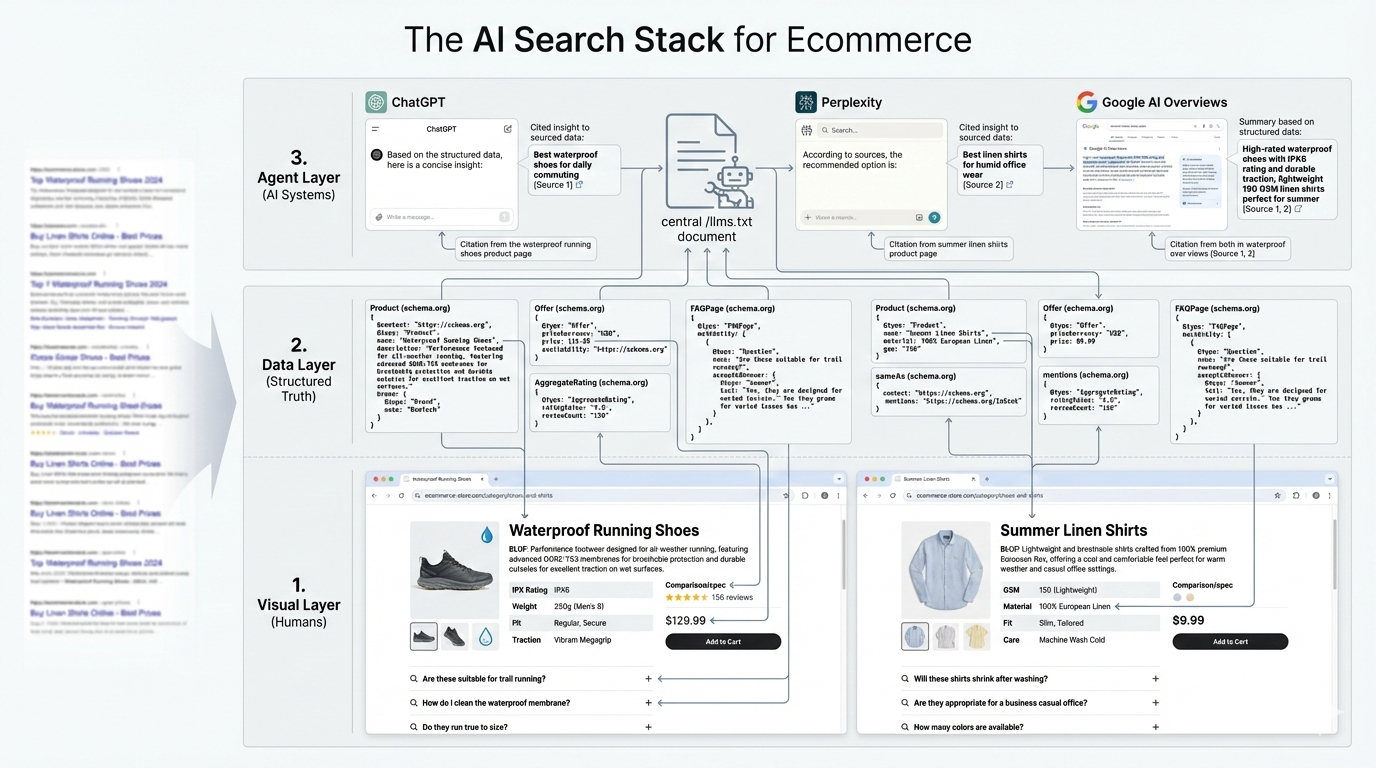
Search is no longer a list of links. It is a reasoning layer.
Modern search systems like Google AI Overviews, Perplexity, ChatGPT Search, and Bing Copilot do not rank pages by keywords alone.
They assemble answers by resolving entities, attributes, and relationships, then synthesizing outputs from sources they trust.
For retail and fashion brands, this creates a hard fork:
Either your catalog becomes machine understandable knowledge, or it becomes invisible in AI-mediated discovery.
This guide lays out a practical, defensible framework for Answer Engine Optimization (AEO), Generative Engine Optimization (GEO), and entity-first ecommerce architecture grounded in what works today, not hype.
1. The Shift: From Keywords to Entities (Why This Matters Now)
Traditional SEO asked:
“Which page matches this query string?”
AI search asks:
“Which sources understand this concept well enough to cite?”
That distinction changes everything.
Multiple industry analyses suggest a steady rise in zero-click and AI mediated search experiences, especially for research, comparison, and “best of” queries. While exact percentages vary by study and vertical, the direction is unambiguous: visibility increasingly happens without a click.
Retail brands are no longer competing only for rankings. They are competing to be referenced.
2. AEO vs GEO (Useful Distinction, Not Dogma)
These terms are often blurred. Keeping them distinct is operationally useful.
AEO – Answer Engine Optimization
Goal: Provide a direct, unambiguous answer
Output: One paragraph, one table, one definition
Success condition: Your content satisfies intent so completely that the user does not need to click.
AEO works best for precise, bounded questions where clarity beats completeness.
GEO – Generative Engine Optimization
Goal: Be cited or referenced in synthesized AI responses
Output: Comparisons, specs, structured facts, original data
Success condition: Your brand or product is named as a source of truth.
GEO is how brands win discovery and authority inside AI-generated answers.
3. The 3-Layer AI-Readable Page Stack
High-performing ecommerce pages now operate as multi-audience documents.
Layer 1: Visual Layer (Humans)
This is still essential, but no longer sufficient.
Requirements:
- Clear H1 aligned to intent
- A BLUF (Bottom Line Up Front) summary in the first 40–60 words
- Comparison tables instead of dense prose
- Real expertise signals (tested by, reviewed by, authored by)
Why it works:
Humans scan
LLMs anchor early context
Tables are parsed more reliably than paragraphs
Layer 2: Data Layer (Search & Indexing Systems)
This is where entities are declared, not implied.
Key practices:
- Product, Brand, and Offer schema via JSON-LD
- Explicit attributes using
additionalProperty - Clear nesting of entities and offers
Optional but powerful:
sameAslinks to authoritative entity references (e.g., Wikidata)mentionsin article schema to connect concepts
You are not “adding schema for SEO.” You are teaching machines what this thing actually is.
Layer 3: Agent Layer (LLMs & AI Crawlers)
This layer is emerging, not standardized, but increasingly relevant.
The /llms.txt convention is not a formal standard yet. Adoption varies by crawler, and compliance is not guaranteed. However, it is:
- Low cost
- Non-breaking
- Increasingly supported by AI tooling ecosystems
Used correctly, it acts as a curated index pointing AI agents to clean, high-signal content.
Correct framing:
An optimization for AI accessibility, not a replacement for robots.txt.
4. Footwear Retail (Example)
Target Query (GEO-style):
“What are the best waterproof running shoes for daily rain commuting?”
Category Page Structure
URL: /mens-waterproof-running-shoes
H1: Men’s Waterproof Running Shoes for Rain & Daily Commuting
BLUF:
Stride waterproof running shoes use hydrophobic membranes and non-slip rubber outsoles, making them suitable for daily rain commuting and short runs. Lightweight builds under 300g and reflective detailing improve all-day comfort and safety on wet urban roads.
Product Schema Example
{
  "@context": "https://schema.org",
  "@type": "Product",
  "@id": "https://stride.com/stormrun-pro",
  "name": "Stride StormRun Pro Waterproof Running Shoes",
  "description": "Lightweight waterproof running shoes designed for urban rain commuting.",
  "brand": {
    "@type": "Brand",
    "name": "Stride"
  },
  "additionalProperty": [
    { "@type": "PropertyValue", "name": "Waterproof Rating", "value": "15000 mm" },
    { "@type": "PropertyValue", "name": "Weight (Size 9)", "value": "280 g" },
    { "@type": "PropertyValue", "name": "Terrain", "value": "Wet pavement" }
  ],
  "offers": {
    "@type": "Offer",
    "price": "145.00",
    "priceCurrency": "USD",
    "availability": "https://schema.org/InStock"
  },
  "aggregateRating": {
    "@type": "AggregateRating",
    "ratingValue": "4.6",
    "reviewCount": "187"
  }
}
This is not decorative. This is machine-level clarity.
5. Apparel: Linen & Lace (Fashion)
Target Query:
“Best linen shirts for humid office wear”
H1: Summer Linen Shirts for Hot, Humid Office Environments
BLUF:
Our 120 GSM linen shirts balance breathability and opacity for humid office conditions. Anti-wrinkle finishing keeps fabric presentable through long workdays, while machine-washable construction supports daily wear.
Attributes
| Attribute | Value |
|---|---|
| GSM | 120 |
| Wrinkle Resistance | High |
| Opacity | Full |
| Best For | Daily office wear |
Structured attributes turn subjective fashion language into objective, indexable knowledge.
6. 90-Day Implementation Roadmap
Phase 1: Entity Foundation (Weeks 1–3)
Identify top category-level intents
Define core entities (products, materials, use cases)
Add BLUF intros and FAQ blocks to priority pages
Phase 2: Structured Data (Weeks 4–6)
Implement full Product + Offer schema
Validate via Rich Results testing
Normalize attribute naming across catalog
Phase 3: GEO Enablement (Weeks 7–9)
Add comparison tables
Add transparency blocks (GSM, origin, care specs)
Improve internal entity linking
Phase 4: Agent Accessibility (Weeks 10–12)
Deploy /llms.txt (optional, experimental)
Publish clean, crawlable guides
Reduce JS barriers on key content pages
Skipping earlier phases weakens later GEO and agent-level gains.
7. Measuring Success (Without Pretending Precision)
Traditional SEO metrics are necessary but incomplete.
Useful indicators:
- Increase in question-based impressions in Search Console
- Brand mentions in AI answers during manual testing
- Stable clicks with rising impressions (zero-click visibility)
- Rich result eligibility and schema health
There is no single “GEO dashboard” yet. Measurement is directional, not deterministic.
Final Takeaway
Retail brands that win in AI search do not optimize content. They publish structured truth.
When an AI system understands that:
- Your shoe has a specific waterproof rating
- Your linen shirt has a defined GSM and use case
- Your catalog behaves like a knowledge graph
You stop competing on keywords and start competing on relevance, trust, and referenceability.
That is the new search game.