Building a Resilient Unified Retail Tech Architecture for 10+ Store Growth
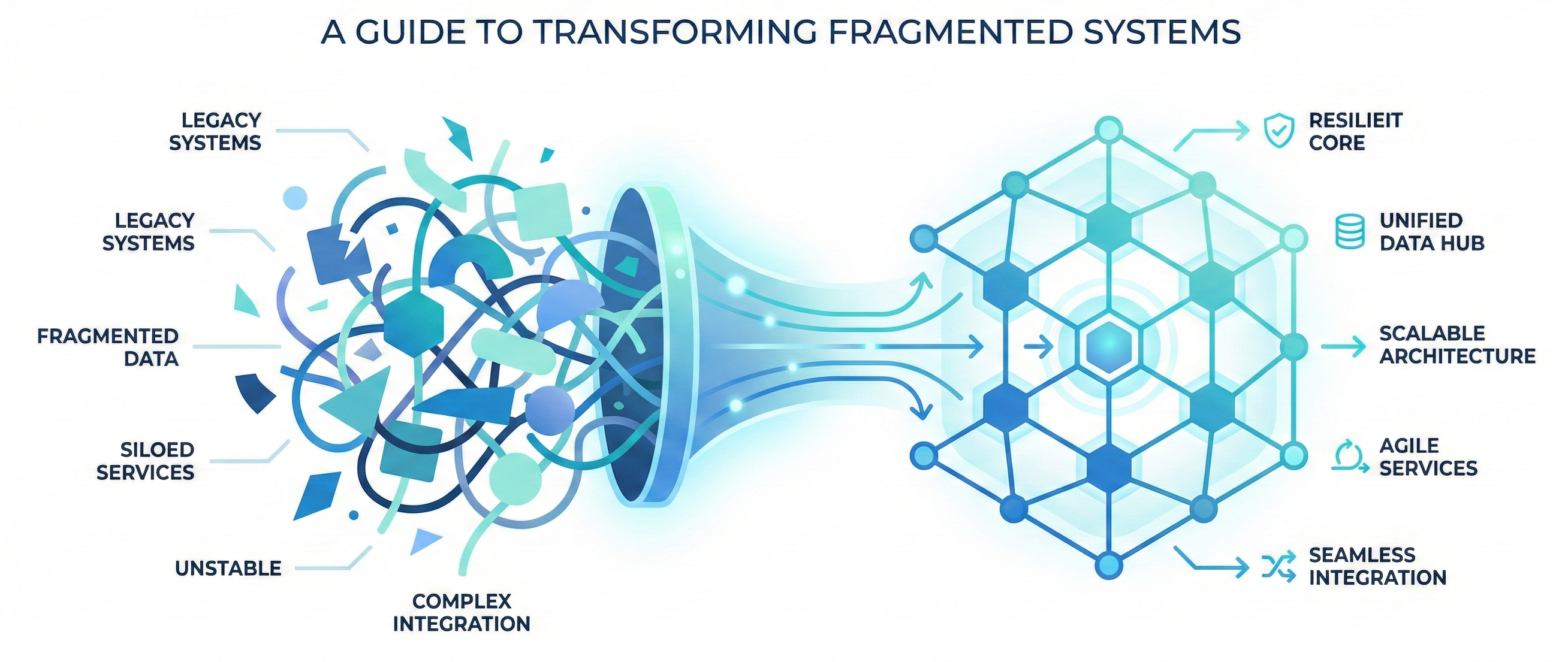
Retail rarely collapses because of poor storefront design.
It collapses because backend systems cannot keep promises.
A business that ran comfortably on one ERP, a POS, and a Shopify storefront suddenly finds itself juggling marketplaces, dark stores, ship-from-store, regional warehouses, complex returns, and tax compliance across states.
Growth multiplies architectural mistakes.
If the entire retail system cannot be explained clearly on a whiteboard in 20 minutes, it is probably too fragile.
This is not a tooling discussion.
It is a systems discussion.
Retail Is Scaling Faster Than Its Architecture
A few years ago, most retailers operated with:
- ERP for accounting
- POS per store
- Basic website
Today the same retailer may handle:
- Own site + marketplaces + social commerce
- 10+ stores and regional warehouses
- BOPIS, ship-from-store, cross-node fulfillment
- Marketplace SLAs
- Reverse logistics across channels
When these run on loosely connected systems, the outcomes are predictable:
- Inventory mismatches
- Order splitting failures
- Manual reconciliation
- Spreadsheet dependency
- Rising WISMO tickets
Scaling does not expose small inefficiencies. It exposes architectural weaknesses.
The Spaghetti Stack Problem
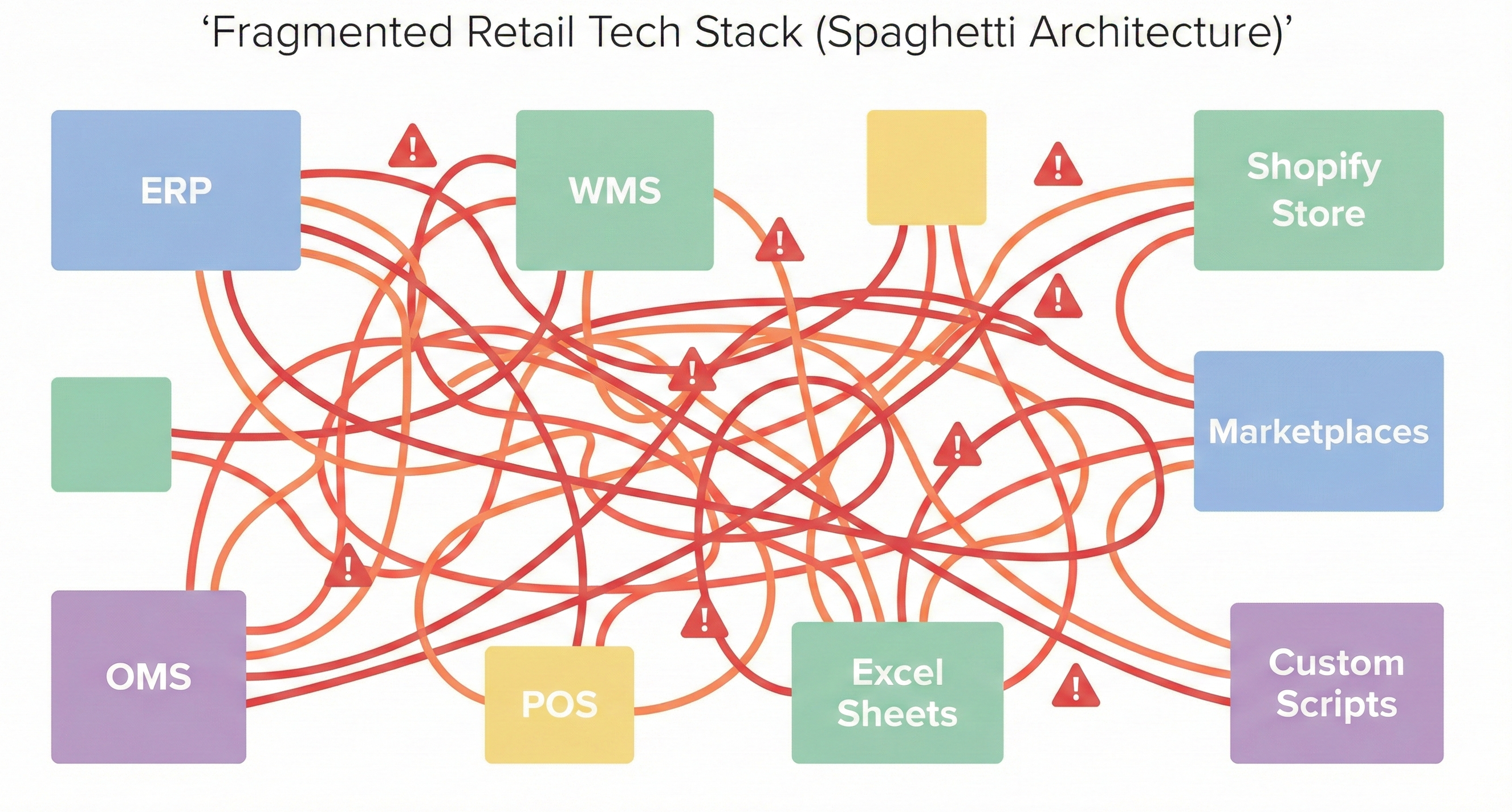
Across mid-market retail, the same pattern appears:
- ERP from one vendor
- WMS from another
- OMS added later
- POS from a local provider
- Shopify as e-commerce
- CSV exports and fragile connectors in between
On paper this looks “best of breed.”
In reality, it behaves like distributed chaos.
What Breaks First
Inventory appears different across systems.
Order splitting logic fails under peak load.
Adding a third sales channel requires a new connector.
Every change demands coordination across vendors.
The problem is rarely one bad product. The problem is architectural drift without a blueprint.
Where Scaling Actually Breaks
Scaling is not linear. It is step-function complexity.
Stage 1 – Manual Workarounds
Spreadsheets bridge ERP and POS gaps.
Stock reconciliations become daily rituals.
Temporary fixes become permanent dependencies.
Stage 2 – Visibility Breakdown
WMS shows one number.
OMS shows another.
ERP shows something else.
Leadership stops trusting dashboards.
Stage 3 – Customer Impact
Split shipments fail.
Cancellations increase.
WISMO spikes.
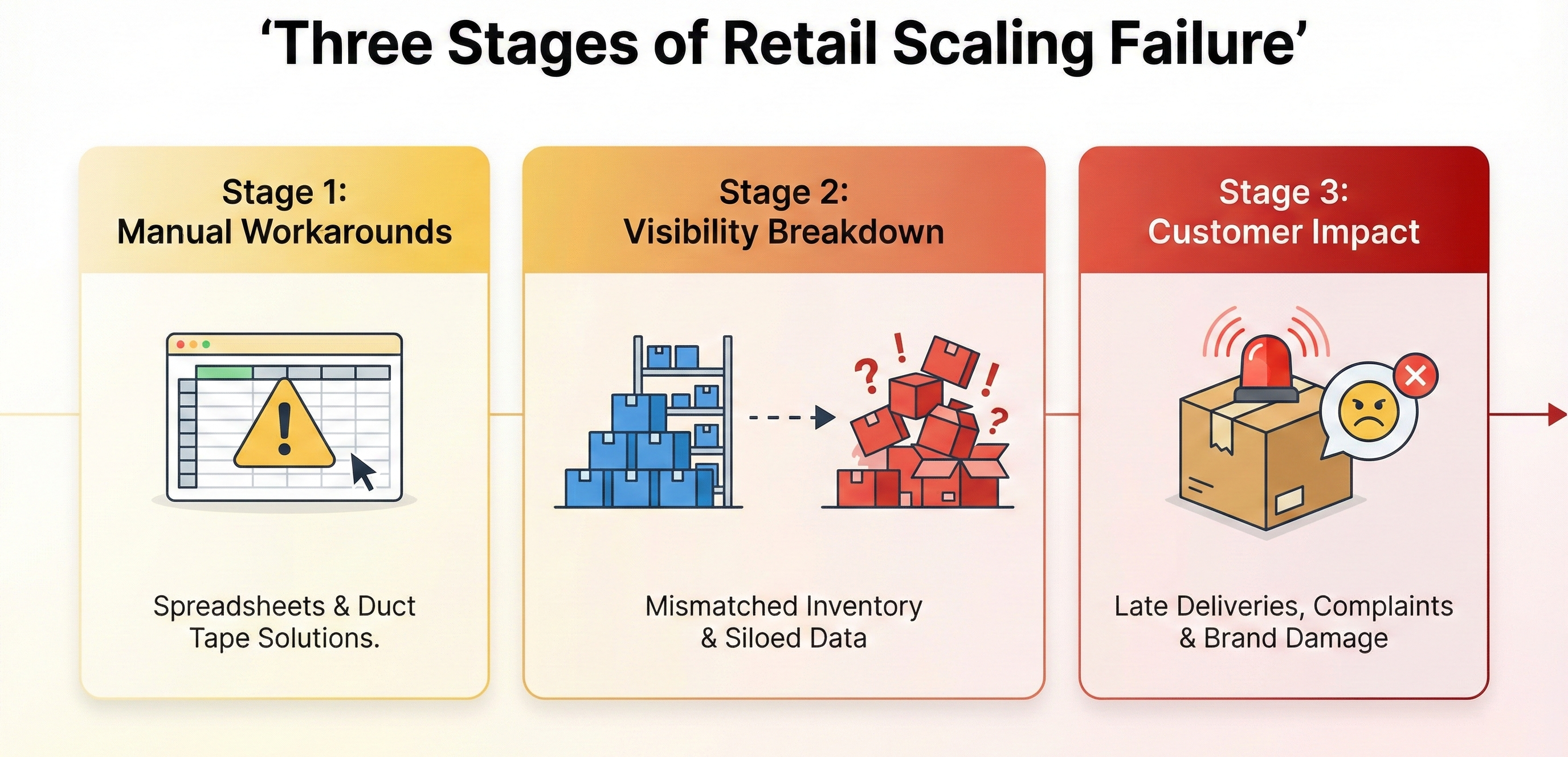
When customers feel your internal misalignment, technology has already failed its purpose.
The Legacy Monolith Trap
Many retailers still operate on tightly coupled monoliths.
In classic monolithic systems:
- UI, business logic, and database are tightly bound
- Single shared database handles all load
- Deployments require downtime
- Any change risks regression
Vertical scaling (adding CPU/RAM) only postpones collapse.
That said, monolith is not automatically bad.
A well-maintained monolith with mature APIs and active development can scale effectively.
The real enemy is stagnation.
Monolith vs Modular: The Real Conversation
The debate is often oversimplified.
Monolithic works when:
- It scales with concurrency
- APIs are mature
- Customization is safe
- Continuous improvement exists
Modular works when:
- Order and inventory workloads scale independently
- Integration maturity exists
- Observability is strong
The ideal for most SMB retailers is neither:
- One rigid monolith
- Nor ten microservices and fifty APIs
It is two to three strong systems with clear ownership boundaries.
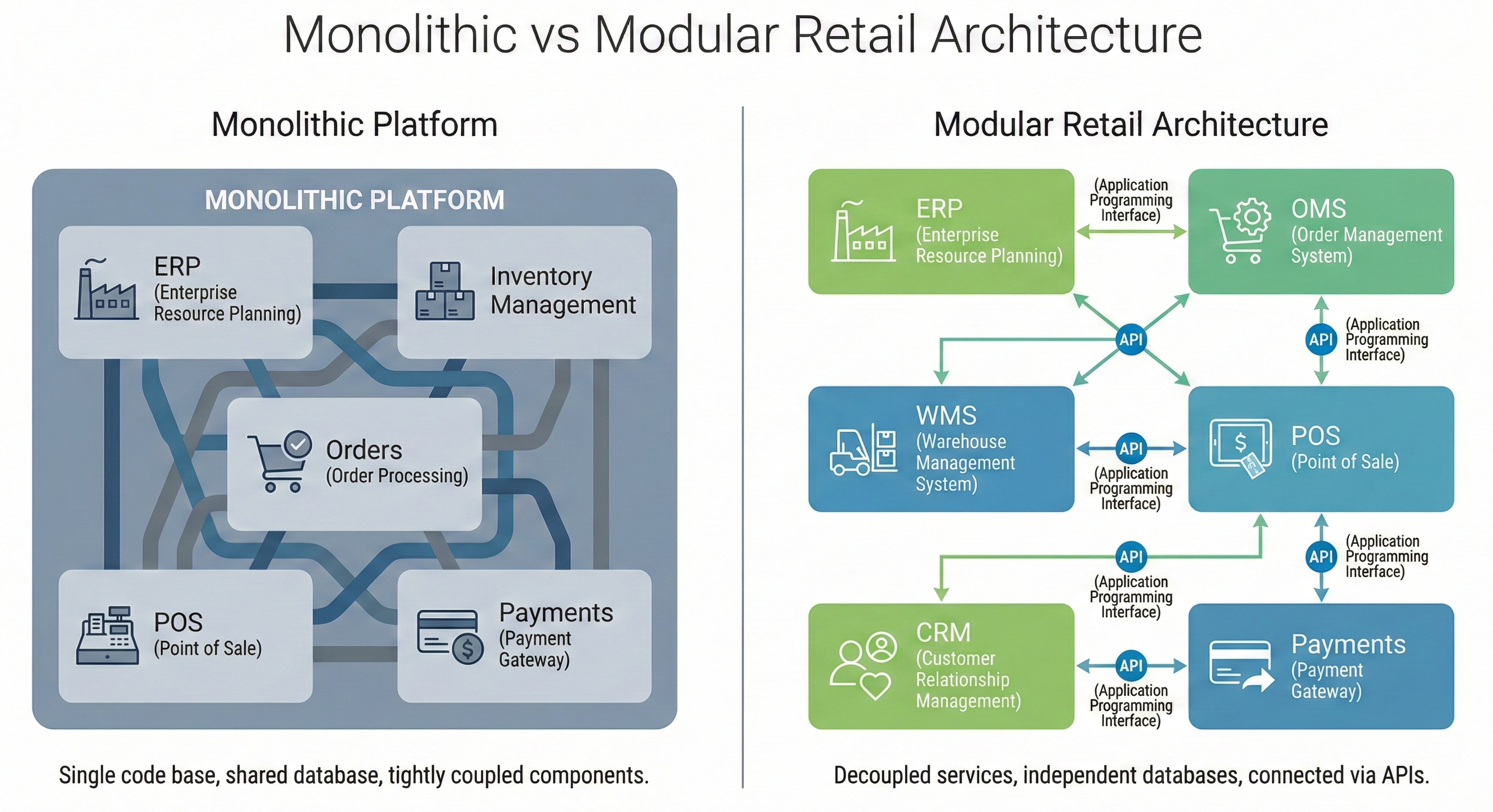
Monolithic is not the enemy. Rigidity is. Modular is not superior by default. Over-fragmentation is equally dangerous.
Unified Commerce: The Architectural North Star
Omnichannel often means stitched channels.
Unified commerce means:
- Single source of truth
- Near real-time data sync
- Inventory visibility across nodes
- Centralized order orchestration
A resilient retail stack typically includes:
Layer 1 — Channels
E-commerce, marketplaces, social, POS
Layer 2 — Orchestration
OMS + WMS
Layer 3 — Core ERP
Finance, procurement, taxation, master data
Layer 4 — Analytics & AI
Reporting, forecasting, optimization
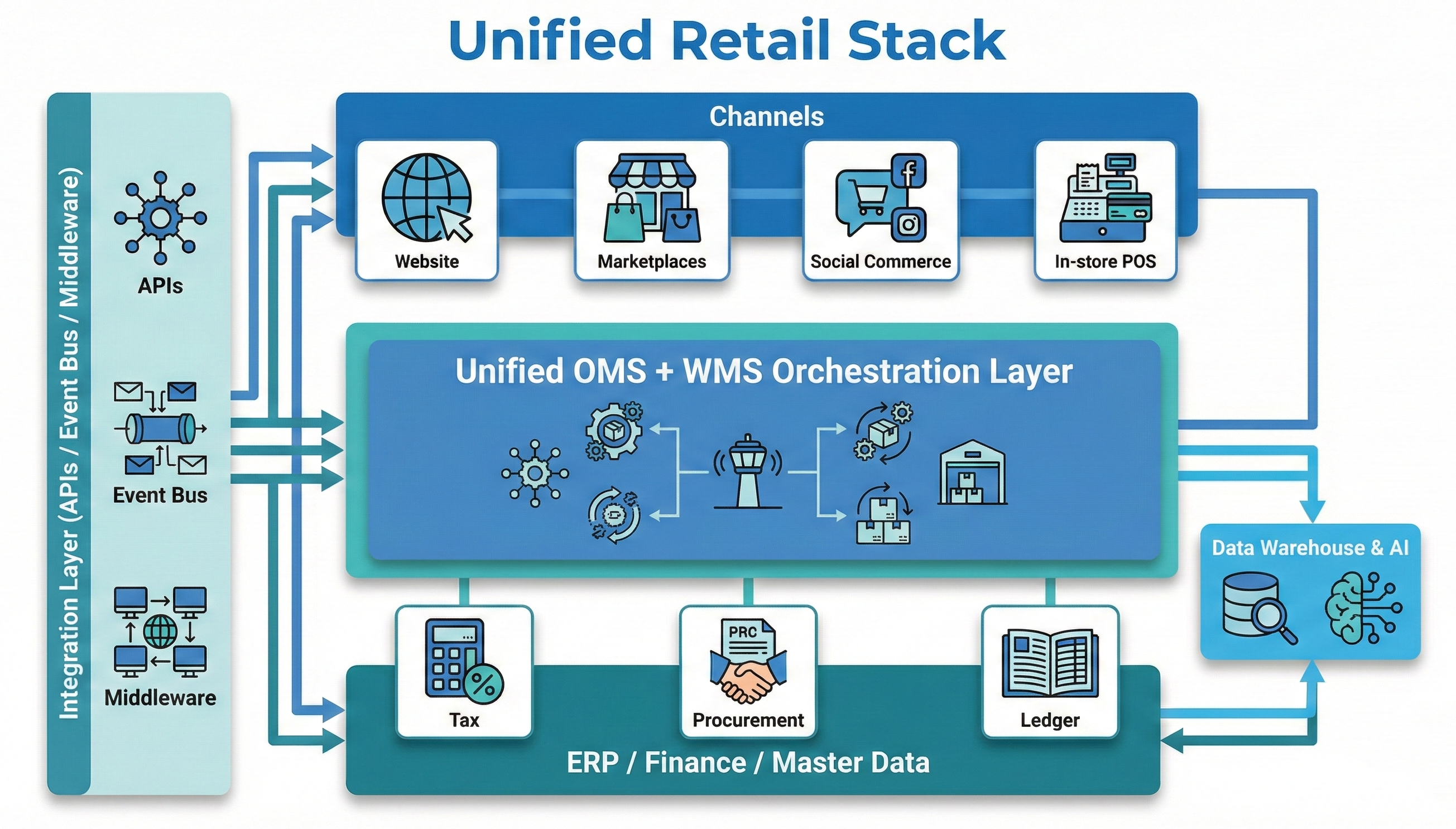
The difference between fragile and resilient systems is not the number of tools. It is how cleanly responsibilities are separated.
Order Orchestration Is Make-or-Break
The OMS is no longer optional beyond 5–10 stores.
It must:
- Split orders across nodes
- Route based on proximity, SLA, and cost
- Reserve inventory virtually
- Sync stock in near real-time
- Support BOPIS and ship-from-store
- Manage reverse logistics
Without orchestration logic, scaling produces manual chaos.
Customers never see architecture.
They see promises kept or broken.
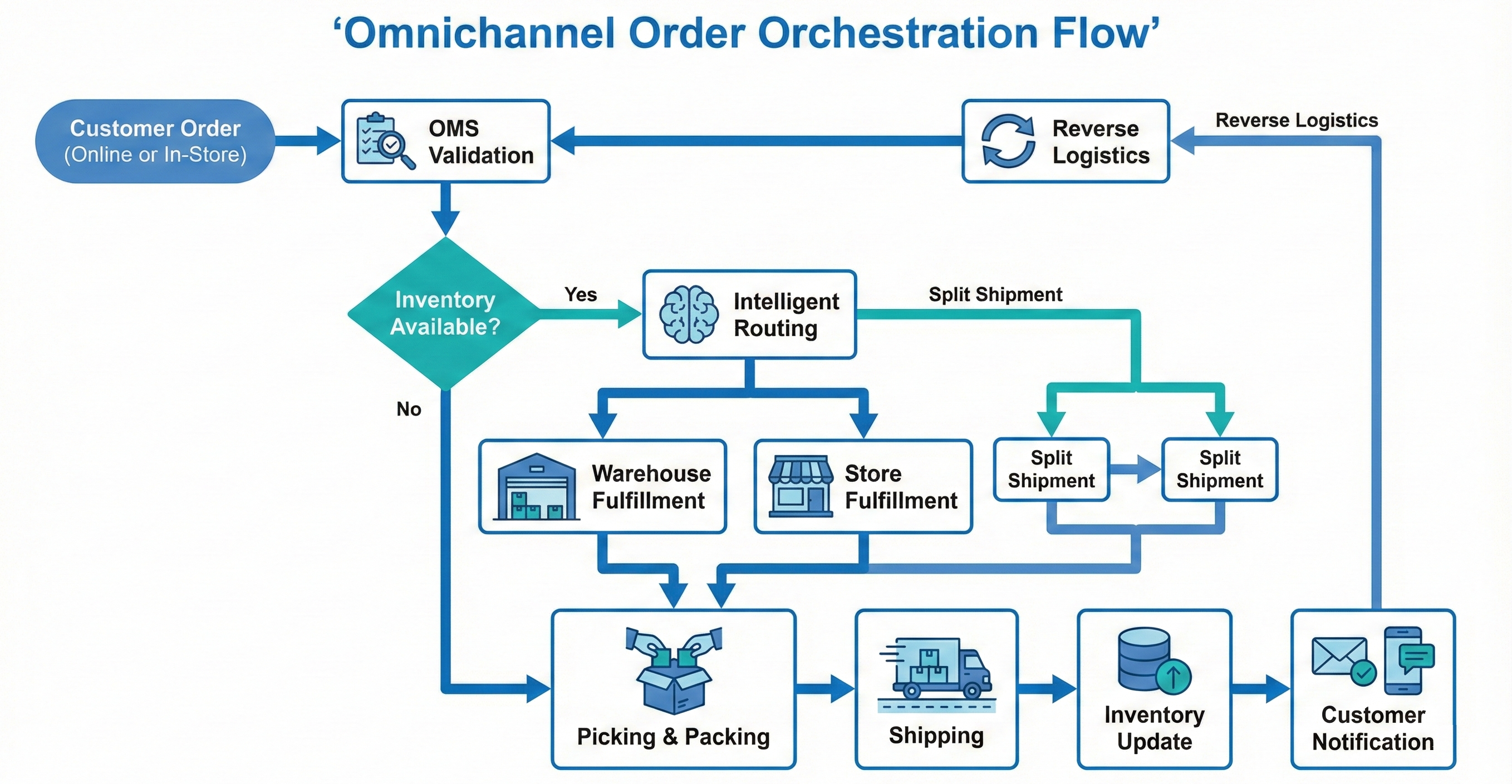
Weak orchestration does not fail silently. It fails publicly.
Integration: API-First or Fragile
Point-to-point connectors multiply risk.
Modern architecture favors:
- API-first design
- Event-driven patterns
- Central integration layer (middleware or iPaaS)
- Observability on data flows
A resilient flow looks like:
- Storefront emits
OrderPlaced - OMS validates and allocates
- WMS triggers picking
- ERP records financial impact
Each system reacts asynchronously.
Failure in one should not crash the entire experience.
The “Power Trio” Model
For most growing retailers, a practical structure emerges:
- Front-end hub (Shopify-class storefront)
- Orchestration layer (strong OMS/WMS)
- ERP backbone (finance + master data)
Fewer vendors.
Clear boundaries.
Lower integration risk.
Reducing vendor sprawl often improves stability more than adding features.
AI Will Amplify Whatever Structure Exists
AI does not rescue chaos.
It amplifies structure.
With unified data, AI enables:
- Predictive demand forecasting
- Automated replenishment
- Intelligent routing
- Inventory anomaly detection
- AI-assisted POS recommendations
Without clean master data and unified visibility, AI compounds fragility.
In the AI-driven retail future, organized systems compound advantage. Improvised systems compound risk.
Vendor Evaluation Through an Architectural Lens
Instead of feature demos, ask:
- Which domains are you system-of-record for?
- How do you handle split orders?
- What happens when integration fails?
- What observability exists?
- What is your largest live deployment?
Architecture conversations reveal long-term resilience.
The Real Shift
Retail maturity is not about adding tools.
It is about reducing fragility.
- From assembling tools → designing systems
- From storefront obsession → orchestration strength
- From reactive reconciliation → real-time visibility
- From fragmented vendors → focused core platforms
The retailers who scale beyond 10+ locations without drama are rarely the ones with the flashiest storefront. They are the ones with the quietest backend.
In modern retail, architecture is invisible.
Until it fails.