Rust: Why It's Becoming Non Negotiable for Retail & Digital Commerce Tech
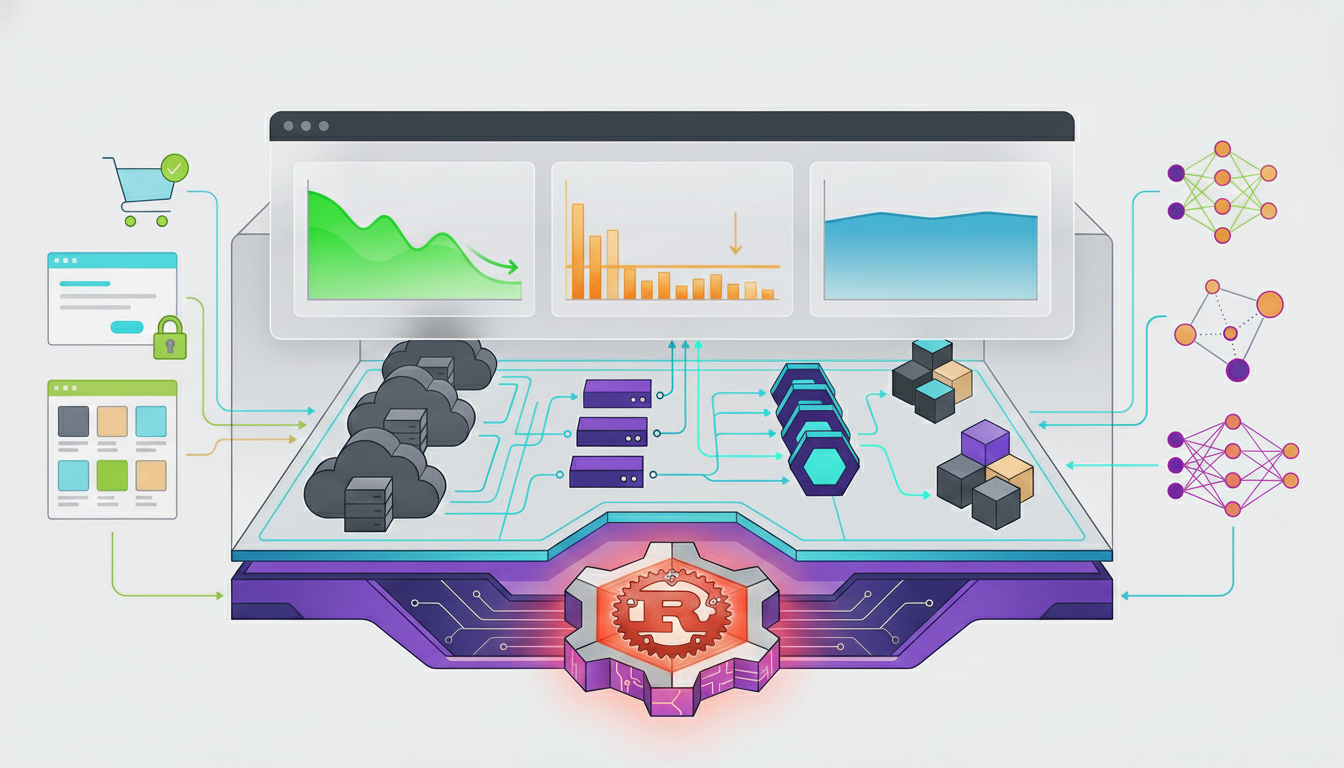
For a long time, Rust was seen as a developer favorite, safe, fast, interesting. But optional.
That changed in 2025.
Rust is no longer a niche language or an engineering experiment, it’s becoming infrastructure. Companies like Google, Microsoft, AWS, Cloudflare, Discord, and Shopify aren’t dabbling they’re rebuilding production‑critical systems around it.
Commercial usage has grown nearly 70% since 2021, and Rust job demand is up 200%+ year‑over‑year the fastest of any language. These aren’t vanity metrics. They’re market signals.
For leaders responsible for retail and e‑commerce platforms, this shift deserves attention.
What’s Actually Driving This
Is not a Hype, three forces converged and none of them are temporary.
1. Security Became a Business Problem
Across large platforms, roughly 70% of serious vulnerabilities come from memory safety issues buffer overflows, use‑after‑free bugs, race conditions. Rust eliminates most of these at compile time not through better testing or more monitoring, but by design.
Google’s Android team reports 0.2 memory‑safety bugs per million lines of Rust, versus ~1,000 per million for C/C++ -> a 1000× reduction. With more than 5 million lines of production Rust, Android drove memory‑safety vulnerabilities below 20% of total CVEs (down from 76%).
That single shift changed their entire vulnerability curve. Rust changes also have 4× lower rollback rates and need 25% less review time than C++.
This isn’t about “cleaner code.” It’s about:
- fewer incidents,
- fewer emergency patches,
- lower regulatory and brand risk.
Rust shifts effort left more thinking and compile time rigor up front, in exchange for far fewer surprises and incidents in production.
Security stopped being just a developer concern. It became a P&L concern.
Even regulators are noticing. CISA and the White House now encourage memory‑safe languages for critical infrastructure making Rust a growing compliance advantage. Microsoft Azure’s CTO went further: “There’s just too much risk in adopting or creating new C++.”
2. Cloud Costs Exposed Inefficient Software
As cloud bills grew, inefficient systems stopped hiding.
Teams rewriting services in Rust consistently report:
- 20–50% lower CPU usage
- tighter tail latency
- higher throughput on the same hardware
Cloudflare’s Rust based edge proxy (Pingora) now handles close to 20% of global internet traffic, delivering a 25% performance boost while using about half the CPUs of its predecessor.
Discord’s rewrite from Go to Rust removed 40 ms GC pauses, cut memory usage 40%, and outperformed its hand tuned Go version on every metric.
Figma achieved 100× more concurrent operations after re‑architecting in Rust.
Rust doesn’t magically make systems cheap it makes it safe to get closer to the metal. When the same traffic runs on half the machines, language choice shows up in finance reviews as much as in architecture diagrams.
3. “But Rust Is Hard” The Reality Check
Yes, the learning curve is real. About 45% of developers cite complexity and build speed as early friction.
Enterprises are addressing that head‑on:
- Start small : One critical service (checkout, fraud, or inventory lookup).
- Train deliberately : Google and Microsoft now run internal Rust academies.
- Integrate gradually : Tools like CXX and Microsoft’s Eurydice let Rust live inside existing C++ stacks.
- Use improved tooling : Compile times have sped up roughly 40% since 2023.
The trade‑off is simple:
A few weeks of learning vs. years of memory bugs, outages, and fire drills.
Most large companies have already decided that short‑term friction is worth long‑term stability.
4. AI Made Reliability Non Negotiable
AI workloads are long running, memory intense, and parallel. Memory leaks here don’t crash gracefully, they inflate GPU costs or spoil inference quality.
That’s why Rust is showing up around AI, not inside model training:
- Inference engines
- Edge runtimes
- Schedulers and control planes
Cloudflare’s Infire, an LLM inference framework written in Rust, outperformed Python‑based vLLM by about 7% on H100 GPUs with far lower CPU overhead. At their scale, the outcome was clear: lower cost per token and more reliable edge inference.
Python is still where experimentation happens. Rust is where production stays stable.
Why It Matters for Retail & Digital Commerce
Retail and commerce platforms live at the intersection of performance, cost, and trust. That’s exactly where Rust excels.
- Checkout & Payments
- Predictable p99 latency under flash sale load
- No GC pauses mid transaction
- Memory safe cryptography and PCI secure code paths
- Fraud & Risk Engines
- Deterministic performance for realtime scoring
- Zero GC related latency spikes
- Predictable ML inference at scale
- Inventory & APIs
- Handles massive concurrency cleanly
- Small binaries, fast autoscaling
- Fewer “only happens at scale” failures
- AI‑Driven Personalization
- Rust pipelines or wrappers (Candle/Burn) deliver faster inference
- Lower cost per recommendation
- Safer long running GPU services
Rust isn’t for every part of the stack, it’s for the parts that fail expensively when they go wrong.
Proof It’s Already Mainstream
Microsoft bans new C++ for security critical code and rewrote major cryptographic components in Rust; Windows now ships with Rust in kernel modules.
Google Android cut memory‑safety bugs 1000× and reduced total vulnerabilities below 20%.
AWS built Firecracker powering Lambda and Fargate in Rust and now offers SLA‑backed Rust runtimes.
Shopify adopted Rust as its official systems language, using it for high throughput commerce logic and WebAssembly based “Shopify Functions”.
Cloudflare’s Rust stack runs major portions of global internet traffic and manages edge AI reliably.
This is no longer isolated experimentation, it’s clear alignment among infrastructure heavy companies.
The Strategic Lens
Rust isn’t replacing every language.
But for security critical, high scale, and cost sensitive systems especially in digital commerce it’s rapidly becoming the default.
The right question isn’t “Should we use Rust?”
It’s “Which parts of our stack are expensive or risky enough that we can’t afford not to?”
- Checkout flows handling billions
- Payment systems under constant scrutiny
- Fraud services analyzing millions of events
- Realtime recommendations at peak load
If those still run on memory unsafe stacks, you’re carrying roughly 70% preventable risk.
That’s the calculus CTOs are starting to make. Rust not as a hobby or trend, but as infrastructure insurance.