The Invisible Marketplace: Why Zero-UI Is the Next Retail Revolution (and Why India Leads the Charge)
Commerce has always moved in one direction: less friction, fewer steps, fewer surfaces between intent and outcome. We went from bazaars to catalogs, from desktops to mobile apps.
Each step compressed effort. Now, retail is approaching the logical endpoint of that compression: the disappearance of the interface itself.
This is Zero-UI commerce.
By the late 2020s, most customer journeys will touch conversational or AI-driven systems somewhere along the path. For retail leaders, this is not another channel to glue onto Shopify; it is a structural change in how discovery, trust, and transactions work.
India is not following this shift. It is shaping it. Voice commerce growth, UPI-powered invisible payments, and vernacular-first users make India a natural Zero-UI laboratory.
If you’re still optimizing for clicks while your customer is speaking, you’re tuning an instrument no one is listening to anymore.
The Decline of the Visible Interface
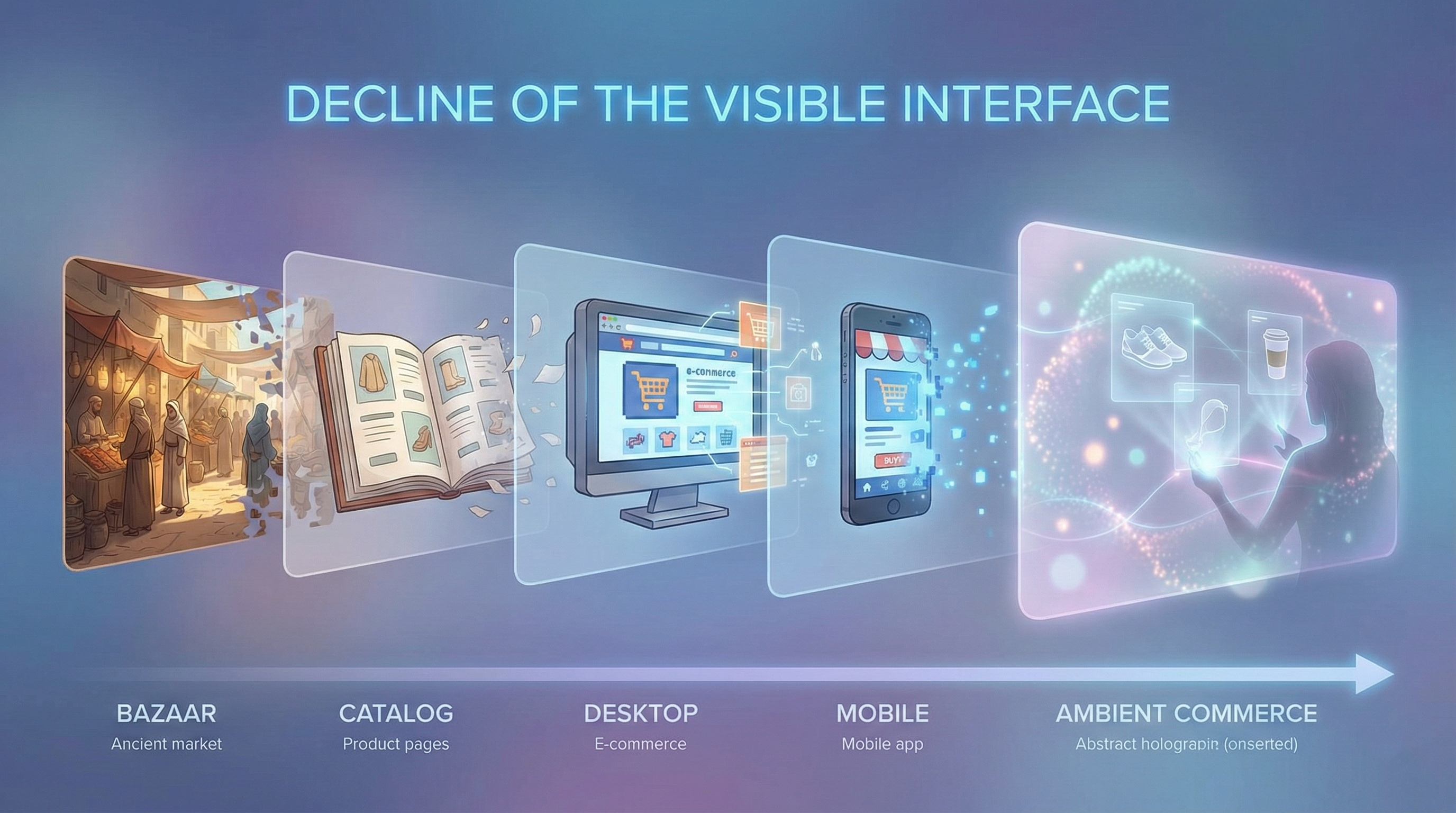
Zero-UI is not anti-interaction. It is anti-screen.
Instead of menus, buttons, and flows, the interaction surface dissolves into voice, context, automation, and environment. The user stops navigating software. The software starts navigating reality.
Some of these patterns are already production-ready. Others are early but inevitable:
- Voice Flows: Shoppers reorder habitual purchases with a simple sentence.
- Gesture-Based Triggers: Contextual price checks happen at the moment of discovery.
- Ambient Systems: Essentials are quietly replenished when inventory runs low.
- Calendar-Aware Automation: Needs are anticipated before a request is ever made.
The ambition is ambient computing: systems that act when intent is obvious, not only when explicit commands are issued.
The Shopper Schism: From Persuasion to Proof
The deepest shift in Zero-UI is not technical. It is philosophical.
The experience remains human. The decision pipeline increasingly does not. A split is forming:
- The Principal (Human): The one who consumes, evaluates outcomes, and feels satisfaction or regret.
- The Agent (AI): The entity that compares options, weighs trade-offs, and executes the purchase.
Traditional marketing is built on persuasion: imagery, aspiration, emotional triggers. Agents do not care about any of that.
They care about proof.
Price history. Defect rates. Verified reviews. Delivery reliability. Sustainability scores. Structured endorsements. Machine-readable facts.
This is where Agent Intent Optimization (AIO) emerges. Think of it as SEO for non-human buyers.
If your product data cannot be parsed, compared, and trusted by an agent, you effectively do not exist in a Zero-UI flow.
Brand does not disappear. It migrates—from glossy creative to durable signals embedded in your data exhaust.
India as the Global Zero-UI Lab

In many Western markets, Zero-UI is framed as convenience. In India, it is access.
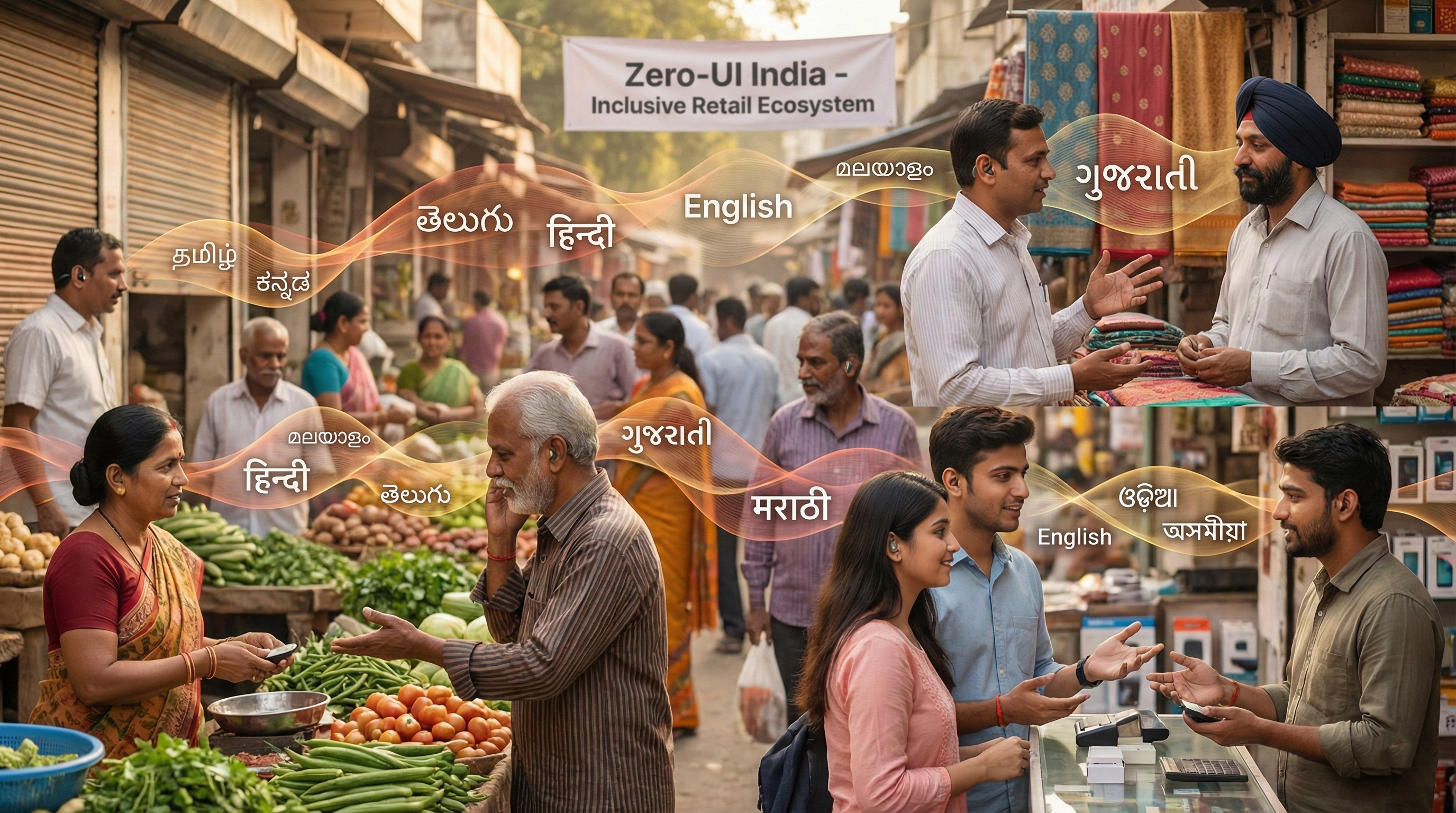
Typing is friction in a country with dozens of languages and uneven literacy. Voice is natural. It lowers the cognitive and mechanical cost of participation.
- Vernacular First: User research consistently shows Indian shoppers finding voice search easier than typing in local languages.
- Discovery Speed: Large platforms report materially faster discovery when voice is available.
- Inclusion: English-only interfaces quietly exclude a massive segment of the population. Voice bridges that gap.
Then there is sound as an interface.

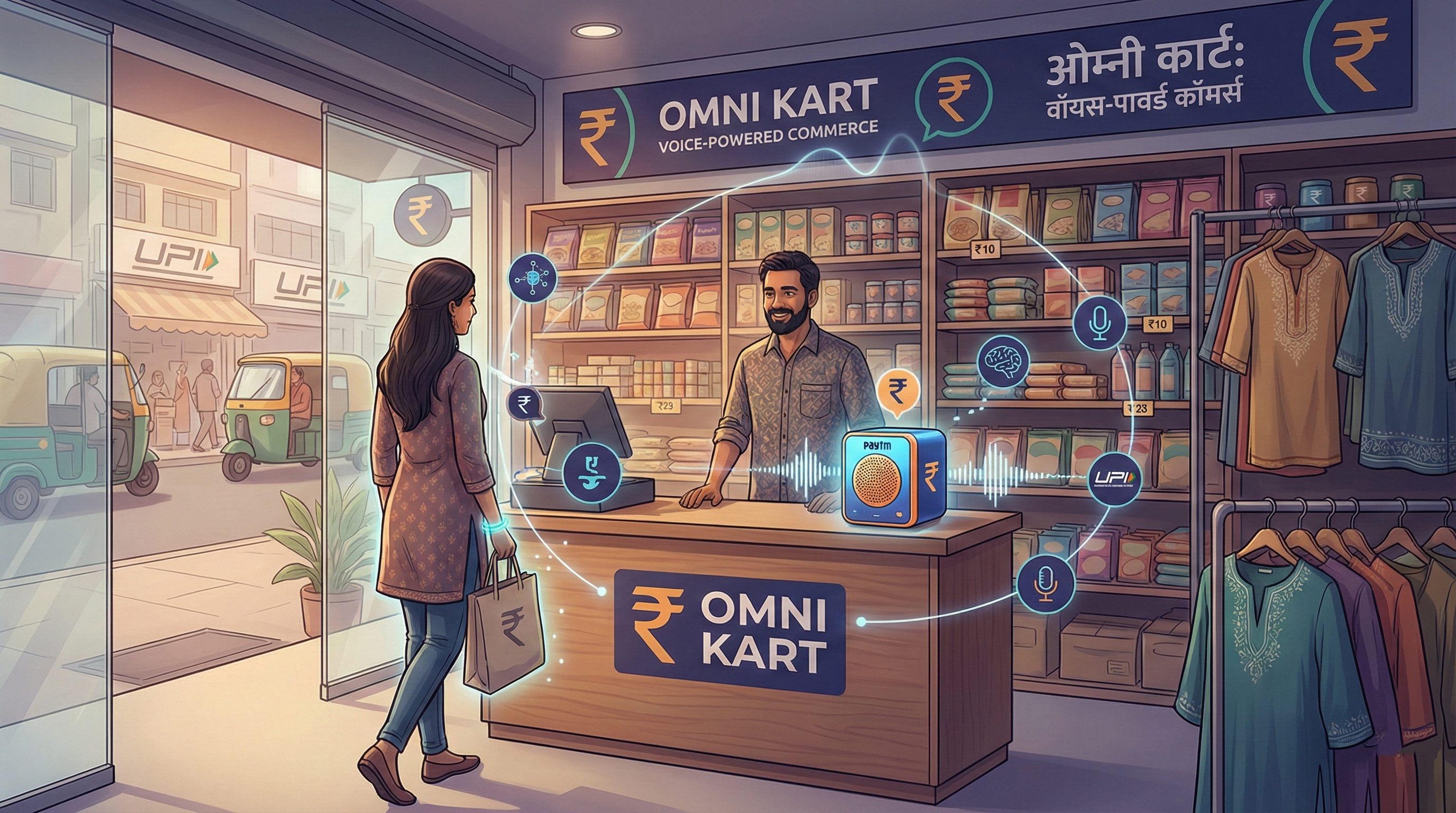
The Paytm Soundbox is Zero-UI distilled to its essence. No app. No screen. Just an audible state change that confirms trust. The spoken receipt replaces visual verification. Sonic branding stops being decoration and becomes functional UI.
Public infrastructure completes the picture. UPI Autopay enables invisible payments—recurring, low-friction, without OTP loops. Used responsibly, it powers ambient commerce. Used poorly, it feels predatory. Consent and control become design primitives, not legal afterthoughts.
The CTO’s Playbook for Zero-UI Retail

For technology leaders, Zero-UI is less about frontend novelty and more about backend reality. Monoliths assume humans click buttons. Zero-UI assumes anything—car, speaker, bot, appliance—can initiate commerce.
That demands change:
Make Headless the Default
The frontend stops being the interface and becomes an interface. “Add to cart” turns into an API call that any agent can invoke. Treat your current webshop and app as just two consumers of a commerce API that voice assistants, IoT devices, and AI agents can call directly.
Over-Structure Your Product Data
If an AI agent cannot read your product specs, you are invisible. Subjective copy gives way to dense, explicit attributes. Schema is no longer SEO garnish; it is survival gear. Replace vague marketing language with machine-readable specifications, guarantees, SLAs, and policies.
Design for Agents, Not Just Humans
Expose price history, stock freshness, defect rates, and delivery reliability as fields agents can query and rank. Build APIs that answer questions like “Which SKU has the lowest defect rate in the last 90 days?” or “What’s the average delivery time for pin code 560001?”
Build Agentic Workflows in Narrow Lanes
Agents will move from recommendation to negotiation and purchase in constrained, high-value flows. Start with replenishment, subscriptions, and spare parts—journeys where agents can safely recommend and transact. Stale inventory feeds do not cause visible errors—they cause silent exclusion.
Invest in Observability
Agent-facing APIs are high-risk surfaces. Every request, response, and decision path must be traceable. When something goes wrong, logs matter more than dashboards. Build alerting for anomalies in agent behavior, not just system errors.
Privacy, Trust, and the Zero-UI Risk Surface
Zero-UI often implies listening systems and background context. That raises real concerns.
India’s Digital Personal Data Protection Act (DPDPA) reframes consent as an ongoing contract, not a checkbox. Privacy-by-design is not optional. Short retention windows, pseudonymized logs, and a kill switch users actually believe in become table stakes.
Trust remains fragile. Cash-on-delivery still dominates large swathes of Indian e-commerce. In screen-less flows, audio receipts and explicit verbal confirmations can bridge that gap—but only if reversals and disputes are painless.
Invisible commerce without visible trust collapses fast.
What Changes by 2027
The Zero-UI transition is not theoretical. Here is what shifts in the next 18 months:
- AI agents pre-filter most options: 60%+ of purchase decisions will be narrowed by agents before humans see shortlists. Discovery becomes agent-mediated, not human-browsed.
- Structured data becomes survival: Product catalogs without complete schema, specifications, and SLAs will be invisible to agents. Manual, subjective product descriptions will not be indexed or compared.
- India exports Zero-UI infrastructure: UPI Autopay, soundbox-style confirmations, and vernacular voice flows will become reference architectures for other emerging markets across APAC and Africa.
- Headless shifts from optional to table stakes: Mid-market retailers will adopt API-first commerce stacks as the default. The question will not be “Why headless?” but “Why not?”
- DPDPA consent models go global: India’s approach to ongoing consent and data minimization will influence regulatory frameworks in Southeast Asia, the Middle East, and Latin America.
What Leaders Should Do Now
Tactical steps to prepare for Zero-UI commerce:
Audit Your Product Catalog
Check what percentage of your SKUs have complete, machine-readable attributes. Do you have structured fields for materials, dimensions, warranties, certifications, and sustainability scores? If not, start filling the gaps now—before agents start excluding you.
Pilot One Zero-UI Flow
Pick a single, constrained use case: subscription management, reorders for repeat customers, or voice-based store assistance. Build it, test it with real users, and measure intent-to-transaction time. Learn in low-risk environments before scaling.
Localize Beyond Translation
Use Indian language models tuned for dialect variations and code-switching, not just English-to-Hindi translation. Test with users who speak Hindi in UP versus Hindi in Maharashtra. Vernacular nuance matters in voice commerce.
Define Consent and Kill Switches Early
Make it obvious how users can pause listening, revoke UPI Autopay mandates, and roll back mistaken transactions. Invisible commerce needs visible control mechanisms. Test your “stop this” flows as rigorously as your “buy this” flows.
Treat AIO as Shared Responsibility
Agent Intent Optimization is not just an engineering problem. Marketing, product, and engineering must co-own how your catalog is structured, tagged, and exposed. Create a cross-functional “agent discoverability” squad with clear KPIs.
The Bottom Line

Zero-UI is not a feature to bolt on later. It is a structural transition already underway.
The retailers winning by 2027 will not be the ones with flashy AI demos. They will be the ones who audited their data until machines could understand it, piloted voice in high-intent flows before competitors, and localized aggressively using models tuned for Indian contexts—not just translated English copy.
The future belongs to brands that are structured enough to be found by agents and distinct enough to be recognized by sound alone.
Zero-UI is not coming. It is already here, quietly removing the screens while most teams are still polishing them.